
Radar vs Camera Launch Monitors
A launch monitor reads each shot you hit and shows how fast, how high and how far the ball would have flown. Radar units read the shot by following the ball after impact, and camera units read the shot by photographing the ball at impact.
Which kind fits you depends mostly on your room. A radar unit sits behind you, so your room needs depth behind the ball, and radar units start at lower prices. A camera unit sits beside the ball or on the ceiling and fits a room with limited depth.
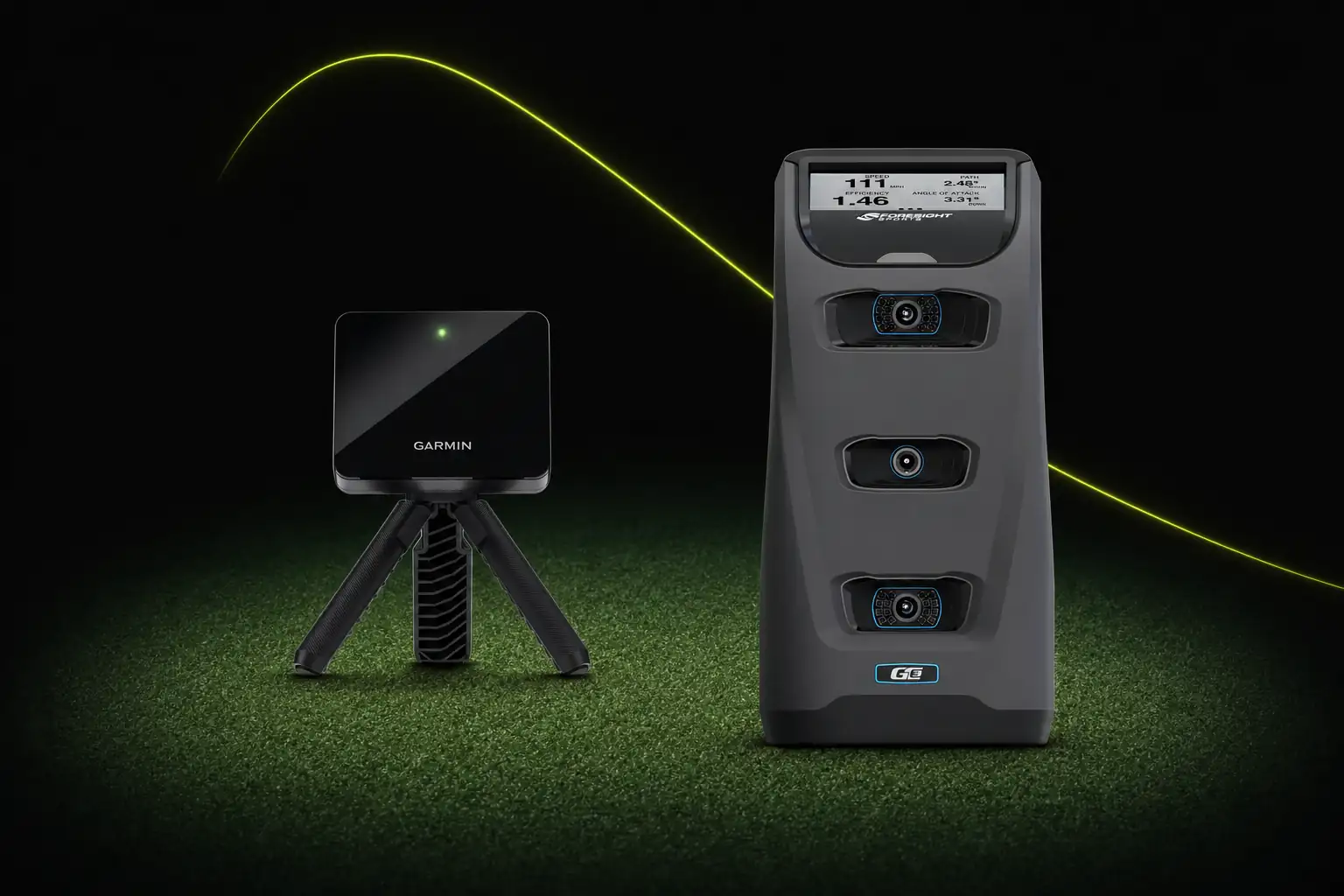
Which to pick
Pick radar if
- your room has several feet of depth behind you as well as in front of the ball
- you want one unit for the range and for home at the lowest price
- left- and right-handed golfers share your setup
Pick a camera unit if
- your room has limited depth behind the ball
- you practice mostly indoors, into a net or screen
- you want spin measured on indoor shots without buying special balls
- you would rather mount the unit on the ceiling and keep the floor clear
How a radar launch monitor reads a shot
A radar launch monitor sits on the ground behind you, facing the target. One radar unit, the Garmin G82, a GPS handheld with a radar inside, stands next to the ball instead. Doppler radar sends out a microwave signal, the signal bounces off the club head and the ball, and the radar reads their speed from the change in the signal's frequency, the same effect that changes the pitch of a passing siren.
From the reflections over the first part of the ball's flight, the radar reads ball speed, the angle the ball climbs at (launch angle) and the direction the ball starts in. Spin is harder for radar. The radar reads spin from the ball's rotation, and the radar picks the rotation up over a long stretch of flight or from a metallic sticker on the ball that reflects the signal strongly. Indoors, the ball reaches the net after 6 ft 6 in to 14 ft, so the radar sees only the start of the flight.
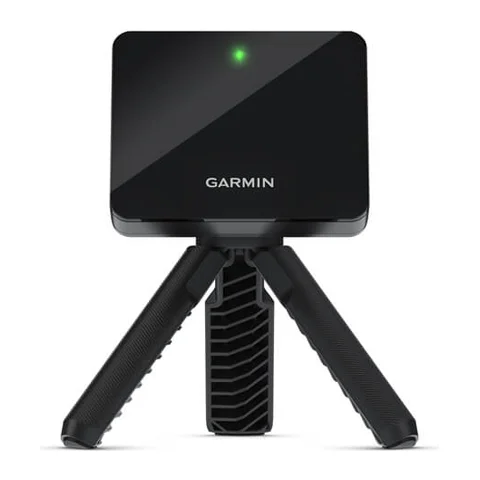
The Garmin R10 shows how this works out. Outdoors, the R10 measures spin when its radar follows the ball for at least 20 meters (about 65 feet) and the ball leaves at 90 mph or faster. Indoors, the R10 measures spin only with Titleist RCT balls, which carry a metallic mark the radar reads, and calculates spin on every other shot.
On r/Golfsimulator and r/golf, 9 golfers who use radar units say they use RCT balls or metallic stickers to get spin indoors, and several find the balls costly; one says they wore out quickly.
How a camera launch monitor reads a shot
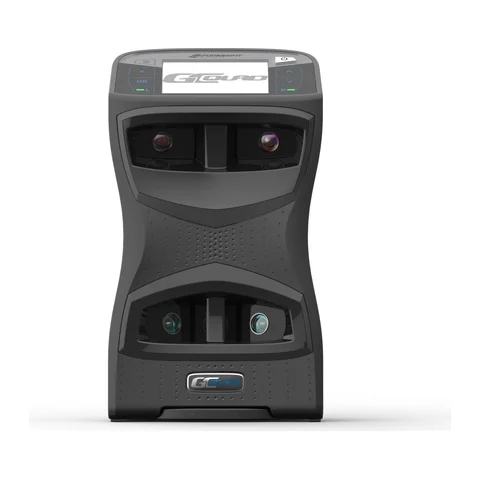
A camera launch monitor, also called photometric or optical, sits on the floor beside the ball, facing you, or on the ceiling above the hitting area. High-speed cameras take a burst of photos of the ball, and on many units the club head, in the few inches around impact.
From how far the ball moves between photos, the unit works out ball speed, launch angle and launch direction. From how the ball's dimples or printed marks turn between photos, the unit reads spin rate and spin axis, the tilt of the spin that curves the ball left or right. Club data comes the same way, from photos of the club head, and some camera units need small stickers on the club to read club data.
A few camera units read spin only from marked balls. The Square Golf Home Edition measures spin with the marked balls in its box and calculates spin with a regular ball, and the NVISAGE N1 needs NVISAGE marked balls.
The Square Golf Home Edition vs Square Golf Omni comparison covers what the Home Edition reads with its marked balls and what the Omni reads with a regular ball.
Launch monitors that use radar and cameras
Eight units in our list combine the two:
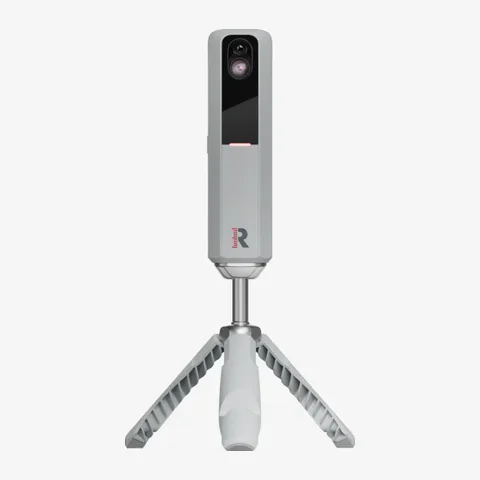
- Radar for the ball, with a camera added: the FlightScope Mevo Gen 2, FlightScope Mevo+, FlightScope X3C, Rapsodo MLM2PRO and Trackman 4. The radar reads the ball's flight, and the camera adds alignment and, depending on the model, video and some of the club or spin data.
- A camera for the ball and radar for the club: the SkyTrak ST MAX and SkyTrak+.
- Radar and a high-speed camera together, mounted on the ceiling: the Trackman iO.
How much room each kind needs
A radar unit needs depth. The unit sits behind you, you swing in front of the unit, and the ball needs room to fly to the net so the radar can read the ball. A camera unit sits beside the ball or above it, so all of the room's depth goes to your swing and the ball's flight. What each placement needs:
- Radar, on the floor behind the ball: 3 ft 6 in to 10 ft behind the ball, and 6 ft 6 in to 14 ft from the ball to the net. Where a maker gives both distances, the unit sits 11 ft 6 in to 18 ft from the net. The Garmin R10, for example, sits 6 to 8 feet behind the ball with at least 8 feet to the net, so at least 14 feet from the unit to the net, plus the depth of the net or screen frame.
- Camera, on the floor beside the ball: no space behind you. The Garmin R50, for example, needs at least 8 feet from the ball to the net and a ceiling of 9 feet or more.
- Camera, on the ceiling: a ceiling of at least 8 ft 3 in to 9 ft 6 in, depending on the model.
Where the unit sits also decides whether the unit has to move for a left-handed golfer. A radar unit behind the ball works for left- and right-handed golfers in the same spot. Most camera units on the floor sit on the golfer's side of the ball and move to the other side for a left-handed golfer, and ceiling units serve both.
On depth, 11 owners on r/Golfsimulator and r/golf describe the space behind and in front of the ball their radar unit needs, and several with a room of limited depth chose a camera unit beside the ball to save that depth.
If your room has limited depth, see Best Launch Monitors for a Garage or Room With Limited Depth for the units that fit it.
In a garage, the door, its opener and a parked car also take space, and the guide to setting up a golf simulator in your garage covers where the launch monitor sits and how much ceiling, depth and width a garage needs.
What each kind measures and what it calculates
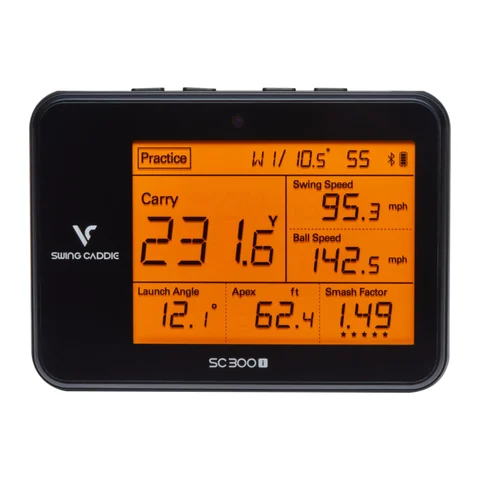
Every launch monitor measures some numbers and calculates the rest from them. Indoors, all 56 launch monitors in our list calculate carry: none sees the ball land, so the software simulates the flight from ball speed, launch angle, launch direction and spin.
The software uses spin to work out how high the ball climbs, how far the ball carries and how much the ball curves, so when spin is calculated and the figure is off, the simulated ball lands in a different place. Spin is also where the two kinds differ most. Indoors with regular balls, 25 of the 28 camera units measure spin rate, and the 20 radar units split this way:
- Calculated: the Blue Tees Rainmaker and Garmin R10 (the R10 measures spin with RCT balls)
- Measured with metallic stickers or RCT balls: the FlightScope Mevo
- Unconfirmed: 6 units whose makers haven't confirmed whether spin is measured or calculated indoors
- Not supported: 11 units
Spin axis, the tilt that curves the ball, is measured by 25 camera units and by none of the radar units.
Club data follows the same split. Club path is the direction the club travels through impact: 21 of the 28 camera units measure club path, and 2 more with a subscription, against 1 radar unit.
| Radar (20) | Camera (28) | Radar and cameras (8) | |
|---|---|---|---|
| Spin rate | 1 measured with metallic stickers, RCT balls or marked balls, 2 calculated, 6 unconfirmed, 11 not supported | 25 measured, 1 measured with metallic stickers, RCT balls or marked balls, 1 calculated, 1 unconfirmed | 3 measured, 4 measured with metallic stickers, RCT balls or marked balls, 1 not supported |
| Spin axis | 2 calculated, 2 unconfirmed, 16 not supported | 25 measured, 1 measured with metallic stickers, RCT balls or marked balls, 1 calculated, 1 unconfirmed | 3 measured, 3 measured with metallic stickers, RCT balls or marked balls, 1 calculated, 1 not supported |
| Club path | 1 measured, 1 calculated, 1 unconfirmed, 17 not supported | 21 measured, 2 subscription only, 2 unconfirmed, 3 not supported | 7 measured, 1 subscription only |
| Face angle | 1 calculated, 1 unconfirmed, 18 not supported | 11 measured, 3 calculated, 2 unconfirmed, 12 not supported | 7 measured, 1 not supported |
Unconfirmed: the maker hasn't confirmed whether the unit measures or calculates this number indoors.
Using each kind outdoors
All 20 radar units are rated for outdoor use. Outdoors, the radar follows the ball for much of its flight, which is how the R10 can measure spin outdoors. Camera units depend on where they mount:
- On the floor: 13 of the 17 floor camera units are rated for outdoor use, and the Bushnell Launch Pro Indoor, Square Golf Home Edition, Uneekor Eye Mini Core and Uneekor Eye Mini Lite are indoor units.
- On the ceiling: 10 of the 11 ceiling units are indoor units, and the other, the Foresight Falcon, works outdoors under a full cover.
- In sunlight: a camera unit outdoors still sees only the first few inches of flight and calculates the rest, the same as indoors, and 3 owners on r/Golfsimulator and r/golf report misreads in direct sunlight or a bright room.
What each kind costs
Prices for the units in our list run:
- Radar: $180 to $4,999$270 to $7,000
- Camera: $699 to $19,999$1,014 to $30,450
- Radar and cameras: $700 to $25,995$950 to $32,395
Radar units start lowest, and the cheapest camera unit costs more than most radar units.
Our picks at the low end of these prices:
Some units also need a yearly membership for some numbers or for simulator software. Among owners on r/Golfsimulator and r/golf, 10 name the yearly memberships on Bushnell, Foresight and Uneekor camera units as a cost they would rather avoid.
For units that show their numbers with no membership, see Best Launch Monitors Without a Subscription.
What owners of each kind report
On r/Golfsimulator and r/golf, owners report:
- Moving from radar to a camera unit: 12 owners who moved from a radar unit or a radar unit with a camera (most often a FlightScope Mevo+) to a camera unit beside the ball say the camera unit reads more reliably indoors, especially spin.
- Chips and putts: 8 say camera units read chips and putts far better.
- Shot shape on radar: 6 radar owners say the shot shape or club path on screen differed from how the ball curved.
- Shot shape on a camera unit: one owner stopped using a Square Golf unit because it never showed shot shape, and recommends the Garmin R10.
- Radar outdoors: 4 owners who use a radar unit outdoors find its carry numbers accurate and the unit easy to take to the range.
Which launch monitors use radar and which use cameras
Each linked name opens a comparison of that unit.
| Radar | Camera | Radar and cameras | |
|---|---|---|---|
| Up to $750 | Blue Tees Rainmaker, FlightScope Mevo (discontinued), Garmin G82, Garmin R10, GolfBuddy Shot Mate, Izzo Launch Master, Izzo Launch Master Lite, Izzo Launch Master Pro, Izzo Launch Mate, Izzo Launch Mate Mini, Izzo Launch Mate Tour, PRGR HS-130A, Rapsodo MLM, Shot Scope LM1, Stack Radar, Voice Caddie SC200 Plus, Voice Caddie SC300i, Voice Caddie SC4 (discontinued), Voice Caddie SC4 Pro | Square Golf Home Edition | Rapsodo MLM2PRO |
| $750 to $2,000 | None | Bushnell Launch Pro Indoor, SkyTrak, Square Golf Omni, Uneekor Eye Mini Core | FlightScope Mevo Gen 2 |
| $2,000 to $3,500 | None | Bushnell Launch Pro, GolfJoy GDS Pro, GolfJoy Spica 3, TruGolf LaunchBox, Uneekor Eye Mini Lite | FlightScope Mevo+ (discontinued), SkyTrak ST MAX, SkyTrak+ |
| Over $3,500 | Full Swing KIT | Foresight Falcon, Foresight GC3, Foresight GC3S, Foresight GCQuad, Foresight QuadMAX, Garmin R50, GolfIn IDRA II, GolfJoy Rigel 2, GolfJoy Rigel 3, GolfJoy Rigel 3 Pro, NVISAGE N1, NVISAGE NEO-E, ProTee VX, TruGolf APOGEE, Uneekor Eye Mini, Uneekor Eye XO, Uneekor Eye XO2, Uneekor Eye XR | FlightScope X3C, Trackman 4, Trackman iO |
| Radar | Camera | Radar and cameras | |
|---|---|---|---|
| Up to $1,100 | Blue Tees Rainmaker, Garmin G82, Garmin R10, GolfBuddy Shot Mate, Izzo Launch Master Lite, Izzo Launch Mate, PRGR HS-130A, Rapsodo MLM, Shot Scope LM1, Stack Radar, Voice Caddie SC200 Plus, Voice Caddie SC300i, Voice Caddie SC4 (discontinued), Voice Caddie SC4 Pro | Square Golf Home Edition | Rapsodo MLM2PRO |
| $1,100 to $2,500 | Izzo Launch Master Pro | Square Golf Omni, Uneekor Eye Mini Core | FlightScope Mevo Gen 2, FlightScope Mevo+ (discontinued) |
| $2,500 to $5,000 | None | Bushnell Launch Pro, Bushnell Launch Pro Indoor, GolfJoy GDS Pro, GolfJoy Spica 3, SkyTrak, TruGolf LaunchBox, Uneekor Eye Mini, Uneekor Eye Mini Lite | SkyTrak ST MAX, SkyTrak+ |
| Over $5,000 | Full Swing KIT | Foresight Falcon, Foresight GC3, Foresight GC3S, Foresight GCQuad, Foresight QuadMAX, Garmin R50, GolfIn IDRA II, GolfJoy Rigel 2, GolfJoy Rigel 3, GolfJoy Rigel 3 Pro, NVISAGE N1, NVISAGE NEO-E, ProTee VX, TruGolf APOGEE, Uneekor Eye XO, Uneekor Eye XO2, Uneekor Eye XR | FlightScope X3C, Trackman 4, Trackman iO |
Without a Canadian price: FlightScope Mevo (discontinued), Izzo Launch Master, Izzo Launch Mate Mini, Izzo Launch Mate Tour.
For our picks across all three kinds, see Best Golf Launch Monitors.
Comparisons of units of different kinds
These comparisons put units of different kinds side by side:
- Garmin R10 vs Garmin R50: a radar unit against a camera unit
- Rapsodo MLM2PRO vs Square Golf: a unit with radar and cameras against a camera unit
- Garmin R10 vs Rapsodo MLM2PRO: a radar unit against a unit with radar and cameras
- Garmin R10 vs Rapsodo MLM2PRO vs Square Golf: a radar unit, a unit with radar and cameras and a camera unit
- Garmin R10 vs SkyTrak+: a radar unit against a unit with radar and cameras