
How to choose a golf simulator enclosure and impact screen
Choosing the right enclosure and impact screen for your space is no easy task. You'll want to consider the depth you need, the padding you'll want to prevent bounce backs, and the type of screen you want included.
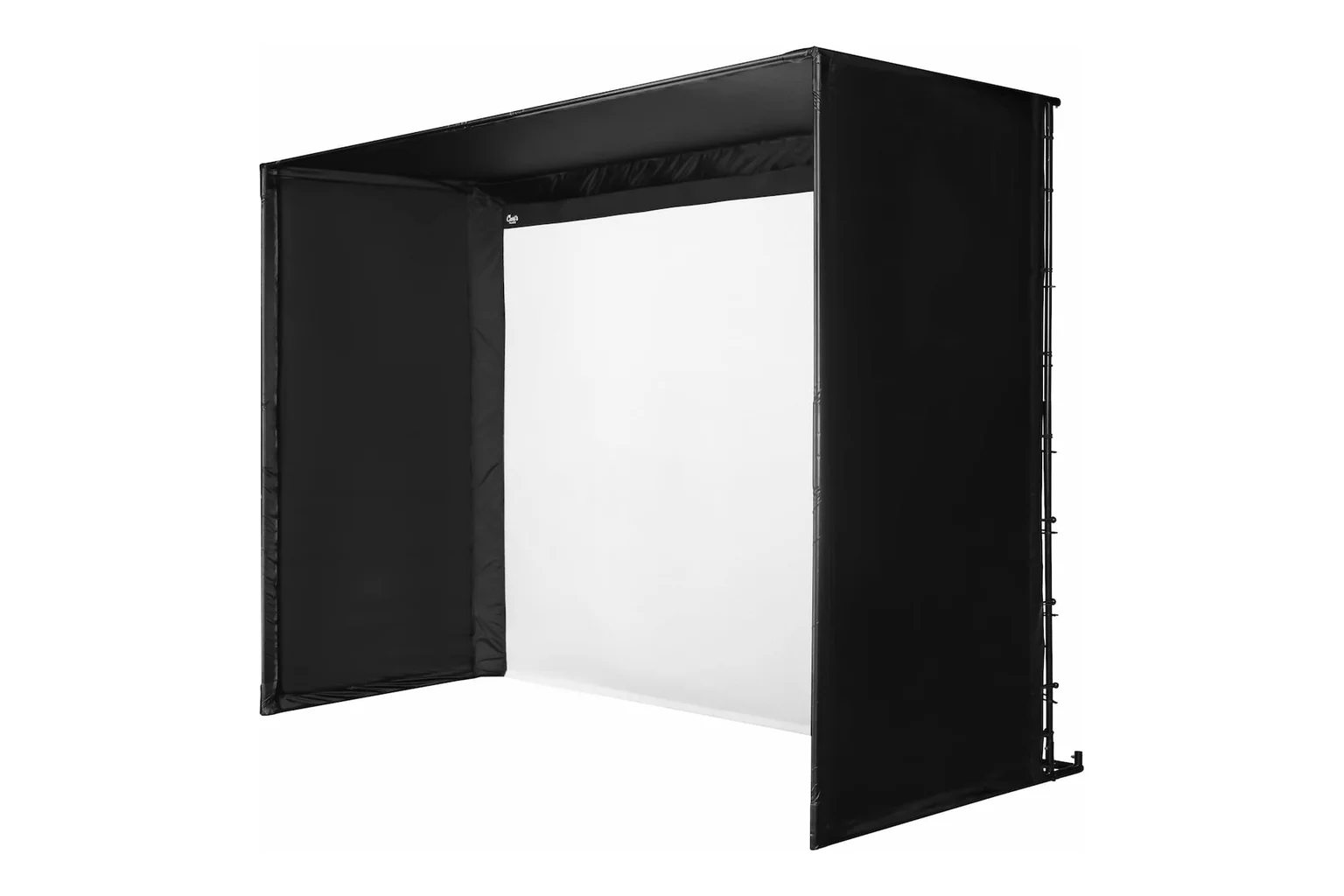
Which kind of screen and enclosure to buy
A golf simulator screen and enclosure come five ways, each shown here with an example and its price:
- An impact screen on its own, such as the Carl's Place Standard from $180CA$350: for a frame you build or a net you already own. Our DIY golf simulator guide covers building the frame.
- A kit you add the pipe to, such as the Carl's Place DIY kit, from $1,000CA$1,820 at 8 by 8 feet: the maker ships the fittings, the screen and the panels, and you buy steel EMT conduit at a hardware store and cut it to length.
- A complete enclosure kit, such as the GoSports 10 by 8 foot enclosure, $1,000CA$1,529: the frame, the screen and the side and top panels that catch shots that miss it, in one box.
- A net with a screen hung on it, such as The Net Return's Pro Series net with the simulator screen made for it, $1,044CA$1,149 for the net and US$249 (about CA$353) for the screen: the net catches the ball, and the screen comes off so the net returns balls to you for practice without the projector.
- A retractable screen, such as the G-TRAK from $2,000CA$2,894: the screen rolls up out of the way, so a garage or family room keeps its other use.
Our nets and enclosures and impact screens pages list every one we track, cheapest first, with photos and prices.
What size impact screen to get
Under a 9-foot ceiling, plan for an enclosure about 8 feet tall: GoSports sizes its 10 by 8 foot enclosure, 8 feet tall, for a 9-foot ceiling, and the SIG12, 9 feet 4 inches tall, may need a ceiling higher than 10 feet, depending on your swing. A taller screen catches more of your high shots, and Carl's Place sells stock screens up to 10 feet tall. Our guide to golf simulator ceiling height and room size covers how much ceiling a swing needs.
Then match the screen's shape to your projector's picture. Screens come square (1:1), 4:3, 16:10 and 16:9; each ratio is width to height, so 16:9 is the widest for a given height. 34 of the 46 current projectors we track have a 16:9 picture, the shape of a TV.
A worked example: the GoSports 10 by 8 foot enclosure's screen is 117 inches wide and 88 inches tall, close to 4:3. A 16:9 picture 117 inches wide is 66 inches tall, so it leaves about 22 inches of the screen blank unless you stretch the picture to fill it. The BenQ AH500ST, a short-throw projector with a 0.499 throw ratio (its distance from the screen divided by the picture's width), throws that 117-inch picture from about 4.9 feet in front of the screen. Our projectors page lists each projector's throw ratio.
Seven owners on r/Golfsimulator who also watch movies on the screen went 13 to 15 feet wide at 16:9 and are happy with the wider screen; several say to get the height golf needs first and accept black bars at the sides of a film.
Which impact screen fabric to choose
Pick a three-layer screen if noise and bounce-back matter to you, as in a basement under the rest of the house or when you hit close to the screen; otherwise owners report that a single-layer or budget screen holds up. Impact screens are woven polyester, in one layer or three, and the fabric changes four things:
- Noise and bounce-back: a three-layer screen has a cushioning middle layer, which SIGPRO says absorbs much of the impact. Elite Screens rates its three-layer screen's rebound at 1.8 feet against 5.2 feet for its one-layer screen.
- Picture: Carl's Place says a tighter weave gives a smoother picture, and calls its three-layer Premium screen the smoothest surface available on an impact screen.
- Color: a gray screen shows deeper blacks; Carl's Place says its gray screen enhances blacks and color, even in bright rooms.
- Ball speed: the screens sold on their own that give a rating are rated for 200 to 250 mph of ball speed, so compare the rating with the driver ball speed your launch monitor shows.
| Screen | From | Fabric |
|---|---|---|
| Carl's Place Standard | $180 | Open weave |
| Rain or Shine Golf impact screen | $289 | One or three layers |
| SIG Preferred | $296 | One layer, tight weave |
| Carl's Place Preferred | $299 | Tight weave |
| Elite Screens ImpactWhite 360 | $371 | One layer |
| SIGPRO Premium | $420 | Three layers |
| Carl's Place Premium | $440 | Three layers |
| Carl's Place High-Contrast Gray | $450 | Three layers, gray |
| SIGPRO Premier Gray | $690 | Three layers, gray |
| Elite Screens ImpactWhite 1145 | $762 | Three layers |
| Screen | From | Fabric |
|---|---|---|
| Carl's Place Standard | CA$350 | Open weave |
| Rain or Shine Golf impact screen | CA$419 | One or three layers |
| SIG Preferred | CA$429 | One layer, tight weave |
| Elite Screens ImpactWhite 360 | US$371 (about CA$526) | One layer |
| Carl's Place Preferred | CA$531 | Tight weave |
| SIGPRO Premium | CA$608 | Three layers |
| Carl's Place High-Contrast Gray | CA$679 | Three layers, gray |
| Carl's Place Premium | CA$745 | Three layers |
| SIGPRO Premier Gray | CA$999 | Three layers, gray |
| Elite Screens ImpactWhite 1145 | US$762 (about CA$1,081) | Three layers |
On r/Golfsimulator, 21 owners were satisfied with budget screens from Amazon and Temu, and several say those screens look and stop the ball about as well as premium ones; one budget screen was still holding after about 8 months. Four owners found cheap single-layer screens loud, with a weaker picture, and some moved up to a three-layer screen.
How far the screen goes from the wall and from the ball
Hang the screen 12 to 16 inches in front of the wall, the gap Carl's Place recommends so the screen can bulge back when a ball hits it. Eight owners on r/Golfsimulator leave 10 to 15 inches, often with foam or a mattress topper in the gap. A freestanding enclosure needs its own gap too: Carl's Place asks for 12 inches behind its kit's frame, and at least 8.25 inches for the rear fittings.
Stand about 10 feet from the screen, the distance Carl's Place plans for, in a room at least 15 feet deep once you add 4 feet behind the ball and the foot behind the screen. Seven owners on r/Golfsimulator hit from 6.5 to 10 feet. Hitting closer works once bounce-back is under control, but owners say the wear concentrates in one spot: one owner hitting from 6.5 feet wore a hole through a Carl's Place Premium screen after a year and a half.
How to hang an impact screen so the ball drops
A tight screen sends the ball back at you, and owners on r/Golfsimulator deal with it in two ways.
Hang the screen loose: 14 owners had balls bouncing back off a screen hung too tight, and fixed it by removing bungee cords, especially at the bottom and sides, skipping every other tie-down, or switching from 6-inch to 8-inch bungees. A longer bungee lets the screen give more when a ball hits it; Carl's Place sells 6-inch and 9-inch ball bungees for its screens.
Fill the gap behind it: 16 owners hang heavy moving blankets, a memory foam mattress topper, duvets or a second screen behind the screen, which deadens the ball and the noise. One owner's three moving blankets make the ball drop nearly straight down. Three owners found cheap moving blankets shredded and their dye stained the screen, and moved to a foam topper or a heavy professional blanket.
How to pad an enclosure so shots stay in it
The hard parts of an enclosure are the frame and the bottom bar under the screen. On r/Golfsimulator, 11 people describe balls ricocheting hard off the thin stock padding of budget enclosures, mostly thin shots off the bottom bar, and people being hit. What owners do:
- Pad or ramp the bottom of the screen: 20 owners do this so low shots go into the screen instead of off the bottom bar or under it. They use a foam wedge, bed wedge pillows, triangle gutter foam (the angled foam strip sold to keep leaves out of gutters), or a strip of foam tile under the turf as a ramp. One owner found that hanging the screen to the floor with a long sandbag behind it worked better than a foam wedge, which still sent low shots back.
- Pad the frame bars: 3-inch memory foam strips behind the stock padding, or pipe insulation under the fabric flaps that cover the frame.
- Wear safety glasses: one owner has everyone in the room wear them, after finding that pool noodles and pipe insulation alone still sent balls back.
Shots also leave over the top. Nine owners had wedges and skied shots slip between the enclosure's roof and the screen, or fly over the enclosure into the wall, ceiling or a TV. They hung a net or blackout curtain behind the screen, or put netting or padding on the ceiling. Our DIY golf simulator guide covers making padding for walls and ceilings.
Whether a budget enclosure kit is good enough
On r/Golfsimulator, 14 owners own a GoSports enclosure, from $1,000CA$1,529 for the 10 by 8 foot size, and say it holds up to regular use: one has played a round a day for almost a year in the 12 by 9 foot size, and another hits in a 10 by 8 four or five times a week through the winter. Most GoSports owners changed the enclosure: they removed bungees for less bounce-back, padded the side and top frame bars, since GoSports lists foam padding only along the bottom of the screen, or fixed a sagging roof.
Another 11 owners own other kits, including SIG, Carl's Place and the SimSpace enclosure sold at Costco, and mostly report easy assembly and good value; one put up a SIG12 in about 2 hours. Sag and padding are their usual complaints too. Seven owners fixed sagging roofs and side panels with paracord straps across the roof, by rolling the fabric tight and adding spring clamps, or with extra bungee ties.
Ten owners built their own frame from EMT conduit and corner fittings, paying a few hundred dollars for the frame, and say the frame is solid. One paid $888US$888 (about CA$1,260) in all for an 8 by 10 foot enclosure, and put a similar Carl's Place enclosure at about $2,300US$2,300 (about CA$3,300).
What every other part costs is in our golf simulator cost guide.
Retractable screens for a garage
A retractable screen rolls up so the car can park, and eight owners on r/Golfsimulator who use one are happy with it, most on a roller bought on its own; one owner has used one in a garage for 5 years. Installing one takes DIY work. The retractable screens we track mount two ways:
- On a wall or ceiling: the SportScreen Vanish rolls up by hand crank or remote, and the HomeCourse ProScreen 180 retracts in under 30 seconds on a battery motor.
- On the garage door tracks: the G-TRAK lowers by wireless remote.
Our garage golf simulator guide covers fitting a screen around the door and its opener.
How to make an impact screen last
Owners on r/Golfsimulator report three things that wear a screen out, and what they do about each:
- Worn balls: 25 people report balls cracking after repeated hits, and scuffed balls marking or burning the screen. They rotate 6 to 24 balls instead of reusing one, hit firmer premium balls such as the Pro V1, Z-Star or TP5, which they say last far longer than soft balls, and retire scuffed balls before they mark the screen.
- Dirt and ink: ten owners clean their clubs, balls and shoes before hitting, and use balls with printed marks or stickers in place of marker dots. To clean a screen, one owner washed it at a laundromat and let it air-dry; another warns against holding a hair dryer on one spot, which melted the fibers into a tear.
- Holes: nine owners wore through the main impact spot or the bottom seam. They patched it with the maker's repair fabric glued on the front and back with spray adhesive, or a store-bought screen patch; one owner found patches didn't last and bought a new screen.