
Will a golf simulator fit in your basement?
A basement golf simulator lets you hit real shots into a screen downstairs and watch them fly on a range or course, all year. Whether one fits usually comes down to two measurements: the height under the lowest beam or duct, and how deep the room is from the screen wall to the back wall.
A simulator is built around a launch monitor, the device that reads each shot, and most launch monitors fit a basement with 9 feet under the beams and ducts and 15 feet deep. Under 9 feet, a launch monitor fits if your driver clears the beams at the top of your swing and at the finish. Enter your basement in our room size calculator to see every launch monitor that fits, with prices.
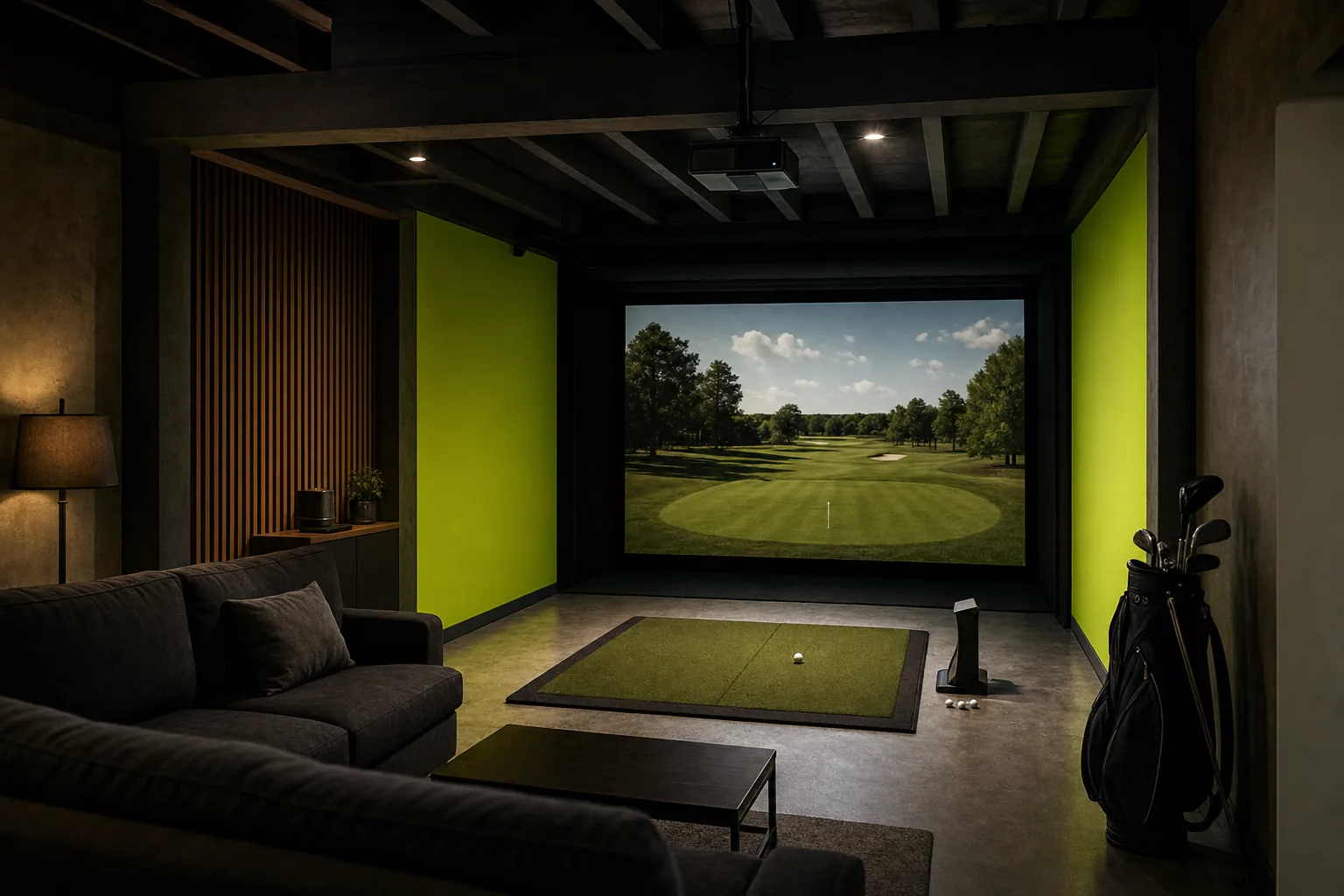
How to measure your basement for a golf simulator
Measure at the spot where you plan to hit:
- Ceiling height: from the floor to the lowest beam, duct, pipe or light above your swing.
- Swing height (ceilings under 9 feet): the highest point your driver reaches at the top of the backswing and at the finish, plus 6 to 9 inches of clearance.
- Depth: from the wall the screen will hang on to the back wall, or to the furnace, stairs or storage in the way.
- Width: wall to wall at the hitting spot.
Five owners on r/Golfsimulator found a duct, beam or joist lower than the ceiling over their swing, and one basement its builder called 10 feet high measured 9 feet 3 inches. Before buying anything, 13 owners swung in the space with slow swings, a foam pool noodle or a broom, and say it showed them which clubs they could hit.
Finishing the room takes height too: five owners report losing inches to drywall, a subfloor, the hitting mat and ducts, up to about 6 inches, and one ceiling of 8 feet 10 inches to the joists finished at about 8 feet 7 inches.
How much ceiling a driver needs depends on the golfer. In threads about basement simulators, six owners with ceilings from about 8 feet 10 inches (to the joists) to 9 feet 6 inches swing a driver, golfers from 5 feet 9 inches to 6 feet 7 inches tall; the tallest credits a flat swing. Three others leave the driver, or anything longer than a 3 wood or a 6 iron, out of play, and one with 9 feet 6 inches skips the driver by choice.
Our guide to golf simulator ceiling height and room size explains how to measure your swing and how much depth and width each launch monitor's maker asks for.
Which launch monitors fit your basement
Every unit needs about 10 feet of width for one golfer (13 feet for Uneekor units, 14 feet for left- and right-handed golfers sharing), and where it sits decides the rest:
- Behind the ball: a radar unit sits on the floor behind you and tracks the ball as it flies toward the screen. Most need 15 to 19 feet of depth, and a few need as little as 12 feet 6 inches.
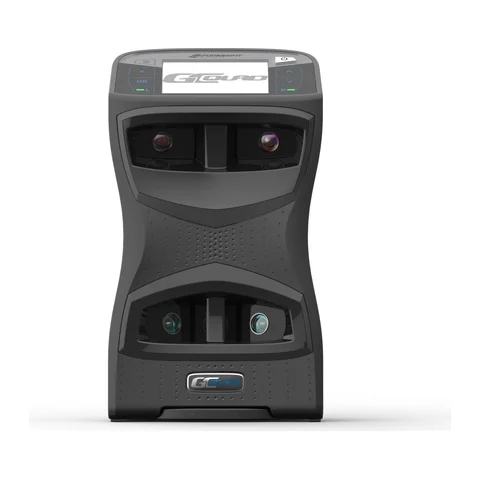
- Beside the ball: a camera unit photographs the ball at impact from the side, so it sits within the width your swing already needs.
- On the ceiling: a camera unit looks down on the hitting area and needs its maker's mounting height. That is at least 9 feet for most ceiling units, and from 8 feet 3 inches for the GolfIn IDRA II.
Each row opens the calculator with that basement filled in, so you can see which units fit, cheapest first, and change any figure to match yours.
| Launch monitors that fit | In the calculator | |
|---|---|---|
| 9 ft ceiling, 13 ft deep, 12 ft wide | 4 of 45 | See which ones |
| 9 ft ceiling, 14 ft deep, 12 ft wide | 7 of 45 | See which ones |
| 9 ft ceiling, 15 ft deep, 12 ft wide | 30 of 45 | See which ones |
| 9 ft ceiling, 17 ft deep, 14 ft wide | 42 of 45 | See which ones |
| 10 ft ceiling, 20 ft deep, 15 ft wide | 45 of 45 | See which ones |
| 8 ft ceiling, 15 ft deep, 12 ft wide, driver swing reaching 7 ft 6 in | 23 of 45 | See which ones |
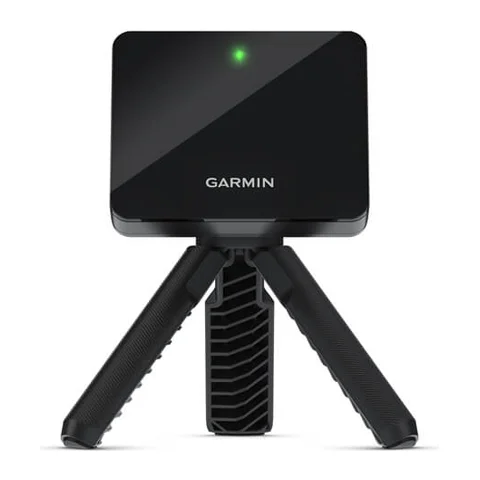
The count jumps from 7 at 14 feet to 30 at 15 feet because most makers of units beside the ball or on the ceiling give no shorter ball-to-screen distance, so the calculator uses the usual 10 feet from the ball to the screen, 4 feet for your backswing and 1 foot behind the screen. Owners do play in less: five owners in rooms 12 to 14 feet deep stand about 7 feet from the screen and hit every club with a camera launch monitor. Under 15 feet, the units whose makers give a shorter setup include the Garmin R50, which sits beside the ball 8 feet from the screen.
For a basement under 15 feet, see which units fit 14 feet in the calculator. If your basement is 15 feet deep but too shallow for a radar unit behind you, our best launch monitors for a room with limited depth picks units that sit beside the ball or on the ceiling.
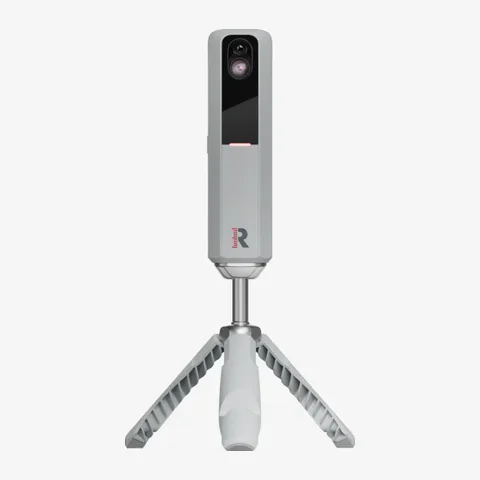
Under 9 feet, the calculator checks each unit on the floor against your swing height plus 6 inches, the low end of Rapsodo's 6 to 9 inches. With a driver swing that peaks at 7 feet 6 inches, 23 of the 45 fit a basement with an 8 foot ceiling, all of them units on the floor.
Once you know which units fit, our overall picks are in the best golf launch monitors, and budget picks in the best golf launch monitors under $1,000 and the best golf launch monitors under $500. A full simulator adds an impact screen to hit into, a projector and a computer; what each costs is in our golf simulator cost guide.
Where to put the hitting spot in a basement
Plan the hitting spot and the padding around four things in a basement:
- Joists, beams and ducts: set the hitting spot where your swing peaks between two joists, away from a beam or duct. Six owners report that most of their ceiling strikes came on the follow-through, so check the space in front of the ball as well as behind it. Three owners kept height by leaving the ceiling over the swing unfinished or with thinner drywall.
- Beams, posts and footings: five owners planned the hitting area around a beam, soffit, post or footing they couldn't move. One owner's structural engineer worked out that a post could move 8 inches, so both posts sit clear of the hitting area. Another put bar seating under the beams.
- Lights and the projector: four owners report a club or ball hitting a light or a projector hung near the hitting spot. Hang the projector in front of the hitting spot, off to one side, or behind you: four owners with basement simulators hang it behind the hitting spot or farther back, where the club passes under it only at the bottom of the swing.
- Pipes, walls and the ceiling around the screen: eight owners describe balls bouncing off hard surfaces into people or property, one into a friend's eye. One owner now covers every exposed pipe with foam fixed in place, and others put thicker padding or foam panels on the ceiling around the screen.
How to get more ceiling height in a basement
Owners gain ceiling height in a basement in two main ways:
- Dig out the floor: break out and lower the concrete under the hitting area, so you stand in a sunken bay below the rest of the floor.
- Open the ceiling between joists: take down the drywall over the hitting spot so the club swings up into the space between two joists.
What owners report about digging out a basement floor
Most basements don't need a dig-out: in the basement threads we read, four owners lowered their floor and the rest play with the ceiling they have. Enter your room in the room size calculator first: if your launch monitor and your swing fit, skip this section. A dig-out is construction work on the house, and its cost is not part of what a simulator costs, so our cost guide and calculator leave it out.
Four owners in threads about basement simulators lowered part of an existing floor for the hitting area, and four owners building a new house had it built lower before the floor was poured. What they report:
- Depth: from 8 inches to 3 feet down. One owner's 2-foot pit, dug by hand and carried out in buckets, took his ceiling from about 7 feet 6 inches to 9 feet 6 inches.
- Engineering: three worked from an engineer's plan or stamped drawings, and the fourth had the foundation underpinned in sections. One owner dug his with his brother, an engineer, in a little over a week. One needed a permit, and one kept an 8-inch step down to meet the building code.
- Cost of the dig-out alone, on top of the simulator: owners who paid a contractor report $25,000 to $45,000US$25,000 to US$45,000 (about CA$35,000 to CA$64,000), and two who got quotes were told $50,000 to $75,000US$50,000 to US$75,000 (about CA$71,000 to CA$106,000). The money goes to engineering, underpinning, digging by hand, drains and new concrete.
- Water: one owner's lowered floor flooded after record rain despite a sump, and the simulator had to be rebuilt. Others put in French drains, a new sump, or gravel under the new slab that leads to the sump.
- In a new house: owners who had the hitting area built lower before the floor was poured say it cost little or nothing extra.
Three owners who priced a dig-out built a detached garage or a shed, or joined a golf club, instead. Our room size guide covers the structural option, replacing joists.
How loud a basement simulator is upstairs
In threads about basement simulators, nine owners say ball strikes are loud in the rooms above, like a slammed door or a gunshot, and one owner's wife texts him to stop so she can sleep.
Seven owners made theirs quieter in three ways. Those who added insulation and drywall to the ceiling report the largest difference, and blankets behind the screen help less:
- The ceiling: rockwool between the joists, a second layer of drywall, and isolation clips or channel to hang it from.
- Behind the screen: moving blankets or a sound blanket, or a screen with several layers.
- The rest of the room: rubber mats on the floor, curtains on the walls, and foam panels on the ceiling or the basement door.